Configure models
This guide assumes you started the Web UI through the root README. Model changes take effect on the next request without restarting the server.
Configure DeepSeek
Open Settings → Models. The DeepSeek card exposes one API-key field; enter the key and save it.
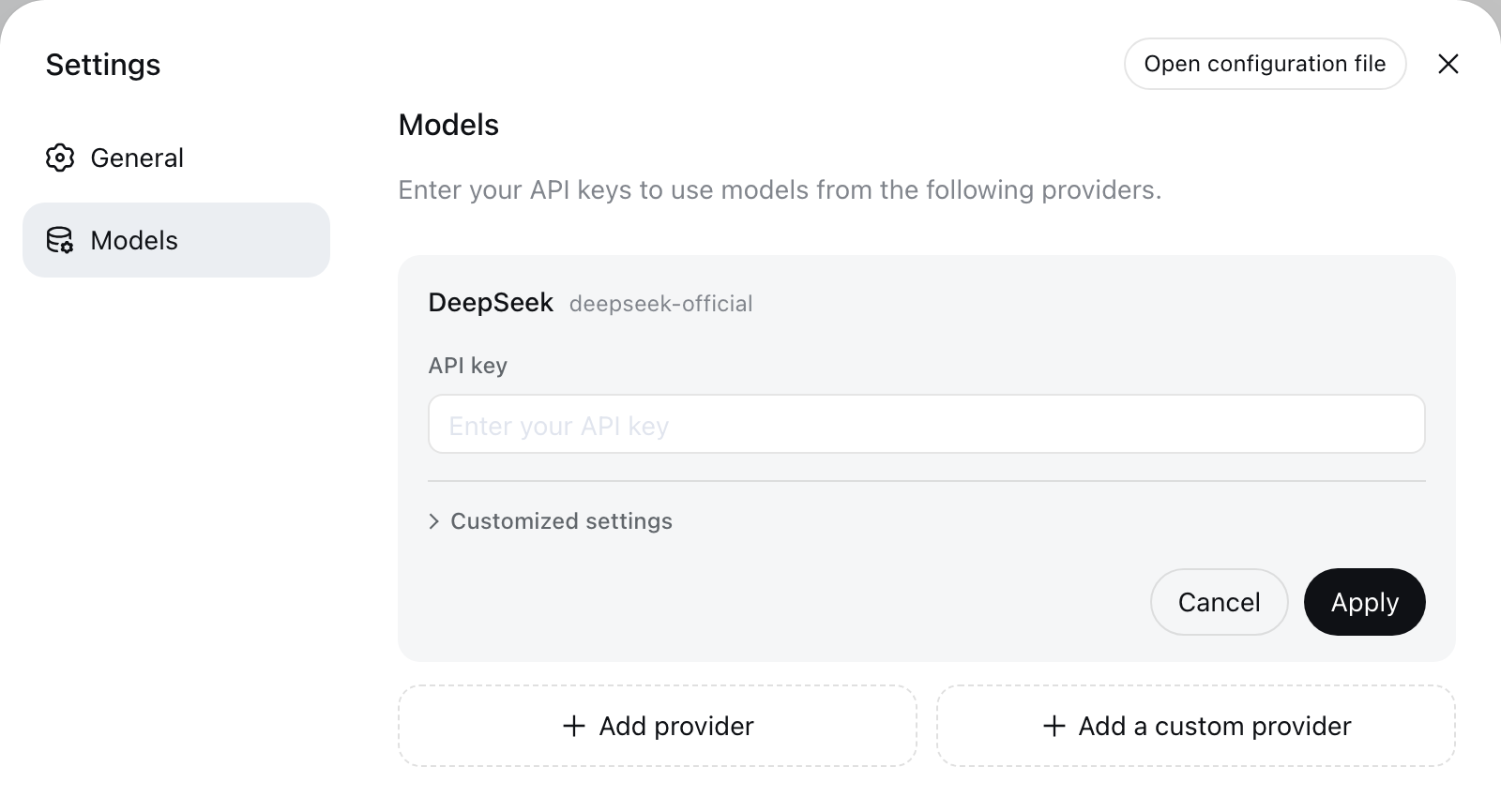
Keys are write-only. The page receives a redacted descriptor after saving, never the literal secret. The key is stored in $DSH_HOME/.credentials.yaml, while settings retain only its credential reference.
Add a built-in provider
Choose Add provider and pick a provider dsh ships with; the list shows provider ids such as anthropic, openai, moonshotai for Kimi, or zai for GLM. Enter its API key and save. The installed catalog supplies the endpoint, protocol, and model list.
Providers that sign in with OAuth, such as Codex, are not supported here yet.
Add a custom provider
Choose Add a custom provider for a company gateway, self-hosted server, or provider absent from the installed catalog. Supply a lowercase Provider ID, base URL, API protocol, credential, and at least one model. The API protocol must be the one your gateway speaks, and the form offers three: openai-completions for OpenAI Chat Completions, openai-responses for the OpenAI Responses API, and anthropic-messages for the Anthropic Messages API. A provider speaks one protocol, so a gateway that serves two needs two providers.
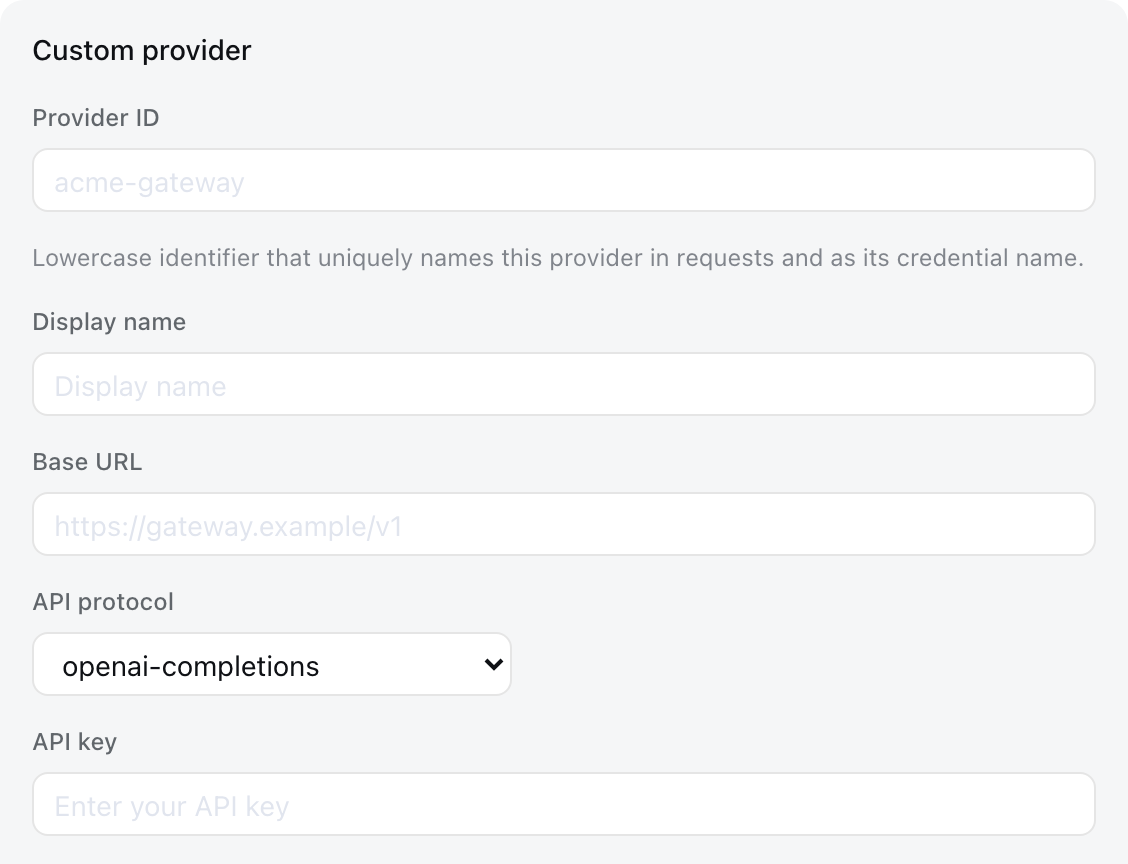
The Provider ID is permanent because requests, saved sessions, model defaults, and credential references use it. To rename a provider, add a new provider and delete the old one. The display name, base URL, protocol, credential, and models remain editable.
Discover models
Under Model catalog, choose Fetch available models to ask the endpoint which models it serves. The request uses the base URL, protocol, and key currently in the form, or a saved provider's stored key, and the reply opens a searchable picker: search, tick the models you want, and choose Add selected. Nothing is stored until you save or create the provider.
Discovery reads the listing formats common gateways publish, but not every endpoint answers in one of them, so treat it as a convenience rather than a guarantee: when it fails or lists nothing, add the model ids by hand and they work just the same. A built-in provider is always answered from the installed catalog, even when its base URL points at a gateway, so fetch through a custom provider to see what the gateway really serves.
Select a model
Configured providers appear in the model picker. Selecting a model also makes it the default for new sessions. A session that has already sent a request retains the model recorded in its own log.
If a saved default names a provider that was deleted, the composer displays Select model and blocks input until another model is selected.
Advanced configuration
The generated plugin configuration catalog lists every supported field and default for every plugin; dsh-llm-pi-ai is the provider section this page configures. The dsh-llm-pi-ai and dsh-llm-deepseek references own direct settings.yaml configuration, catalog resolution, reasoning controls, credentials, and adapter errors.
The form is deliberately small
The Models page exposes only what a route needs to exist: the API key, display name, base URL, API protocol, and for each model its id, display name, context window, and max output tokens. Every other field — reasoning effort levels, image input, request-compatibility switches, headers, timeouts, retry policy — is set in $DSH_HOME/settings.yaml, the same document the page writes. Edit it directly, or, when the browser runs on the same machine as the server, open it with Open configuration file in the Settings header; the adapters re-read it on the next request, so nothing needs a restart. The subsections below cover the fields most gateways need.
Image input
A model you enter by hand is treated as text-only until it says otherwise, because nothing can ask an endpoint which modalities it accepts. Attaching an image to such a model is refused before it is sent, naming the model.
A vision model on a custom provider therefore needs one line. The form has no field for it; add input to the model in $DSH_HOME/settings.yaml:
llm-pi-ai:
  providers:
    my-gateway:
      apiKeyEnv: GATEWAY_API_KEY
      api: openai-completions
      baseURL: https://gateway.example/v1
      models:
        - id: legacy-chat
        - id: vision-preview
          input: [text, image]
input accepts text and image, and applies to that model alone, so one route can serve both kinds. Omitting it — or writing an empty list, which means the same thing — keeps whatever the installed catalog records for that model, and falls back to the route's defaultInput for a model the catalog does not describe.
If every model you entered by hand takes images, set the fallback once on the route instead of on each of them:
llm-pi-ai:
  providers:
    vision-gateway:
      apiKeyEnv: GATEWAY_API_KEY
      api: openai-completions
      baseURL: https://vision.example/v1
      defaultInput: [text, image]
      models:
        - id: first-model
        - id: second-model
defaultInput is a fallback, not an override, and defaults to [text]: on a built-in provider it answers only for models its catalog does not describe, so it never removes images from a catalog model that has them. Narrow one of those with that model's own input. A built-in provider has no models list to put it in, so write it under modelOverrides, keyed by model id:
llm-pi-ai:
  providers:
    anthropic:
      modelOverrides:
        claude-sonnet-4-5:
          input: [text]
Every list must name at least one modality except a model's own, where an empty list means the same as omitting it. An unknown modality is refused wherever it is written.
Both fields state a claim about your endpoint rather than checking it. A model that declares images its endpoint does not serve is not caught here; the provider rejects the request instead.
Reasoning effort
The model picker offers an Effort menu for a model that declares reasoning levels. A built-in provider's models inherit their levels from the installed catalog. A model you enter by hand declares none, so the Effort entry does not appear in the menu and the endpoint's own default decides whether the model thinks. Declare the levels with reasoningEfforts in $DSH_HOME/settings.yaml:
llm-pi-ai:
  providers:
    my-gateway:
      apiKeyEnv: GATEWAY_API_KEY
      api: openai-completions
      baseURL: https://gateway.example/v1
      reasoning: high
      models:
        - id: my-reasoner
          reasoningEfforts:
            off:
            high: high
            max: max
Each key is a level the menu offers, and its value is the spelling sent on the wire as reasoning_effort, so max: xhigh renames a level for a gateway with its own vocabulary. Only off may stay empty, because for most endpoints not thinking is the parameter's absence. The route's reasoning is the level used while a session has picked none; choosing an effort in the picker saves it, with the model, as the default for new sessions.
An off left empty sends nothing, which only stops a model that thinks on request; an off given a value sends that value as reasoning_effort instead. A model that thinks unless told not to — DeepSeek V4 behind an OpenAI-compatible gateway, for example — needs compat.thinkingFormat: deepseek, which makes off send thinking: {type: disabled} and every other level send thinking: {type: enabled} beside the effort:
      models:
        - id: deepseek-v4-pro
          compat:
            thinkingFormat: deepseek
          reasoningEfforts:
            off:
            high: high
            max: max
A built-in provider's model whose gateway does not reason loses its levels with reasoningEfforts: false under modelOverrides; selecting an effort for it is then refused as UNSUPPORTED_REASONING_EFFORT. DeepSeek's own route needs none of this: its models already offer off, low, high, and max, and llm-deepseek.reasoningEffort sets the default the picker starts from:
llm-deepseek:
  reasoningEffort: max
Request compatibility
A gateway can hold a working key at a reachable address and still refuse every request. pi-ai decides the shape of a request — which role carries the system prompt, which field caps the output, how a thinking level travels — from the endpoint's URL, and an address it does not recognize is addressed as though it were OpenAI itself. Most OpenAI-compatible gateways refuse at least one thing OpenAI accepts.
Two account for most of it. A model that declares reasoning has its system prompt sent as role: "developer", which many gateways reject outright, and the output cap is sent as max_completion_tokens, which a server that only knows max_tokens refuses. The form has no field for either; correct them on the route in $DSH_HOME/settings.yaml:
llm-pi-ai:
  providers:
    my-gateway:
      apiKeyEnv: GATEWAY_API_KEY
      api: openai-completions
      baseURL: https://gateway.example/v1
      compat:
        supportsDeveloperRole: false
        maxTokensField: max_tokens
      models:
        - id: my-model
A route's compat is the default for its models, and a model's own wins field by field, so one model can be corrected without restating the route:
      models:
        - id: my-model
        - id: my-reasoner
          compat:
            thinkingFormat: deepseek
What neither sets keeps the installed catalog's value for that model, and what the catalog does not describe falls to pi-ai's detection. Give every switch you name a value: a key left empty (supportsDeveloperRole:) is refused rather than ignored, because an empty value would erase what the catalog knows while saying nothing in its place. A name no protocol accepts is refused too, and the message lists the ones that are available.
Each switch belongs to the protocols that declare it, so a switch valid on one api may be refused on another — the message names what that protocol does offer. Like input above, a switch states a claim about your endpoint rather than checking it: setting one your gateway does not actually need simply sends a different request.
Every switch, its accepted values, and the protocols that take it are listed under PiAiCompatProfile in the generated dsh-llm-pi-ai configuration reference — which is derived from the source, so it cannot fall behind what the adapter accepts.
Troubleshooting
MISSING_CREDENTIAL— Store the provider key through the Models page or supply the referenced environment variable.UNKNOWN_MODEL— Select a configured model or add the missing model to the custom provider.- Fetching available models returns 401 — Check the key. Model discovery calls the OpenAI-compatible
GET /modelsendpoint; enter models manually for endpoints that do not provide it. - Fetching available models reports neither a
dataarray nor amodelsobject — The endpoint's listing is in a format discovery does not read. Enter the models by hand. - The gateway refuses every request although the key and URL are right — Its request shape differs from OpenAI's. Start with
compat.supportsDeveloperRole: falseandcompat.maxTokensField: max_tokenson the route. - Only reasoning models fail — pi-ai sends their system prompt as the
developerrole, which the gateway rejects. Setcompat.supportsDeveloperRole: false. - The Effort menu does not appear for a model you entered by hand — It declares no levels. Add
reasoningEffortsto the model insettings.yaml. offdoes not stop a DeepSeek model from thinking — An emptyoffsends no reasoning field at all, and an endpoint that thinks by default keeps thinking. Setcompat.thinkingFormat: deepseekon the model or the route.- A compat switch is refused as having no value — A key written with nothing after the colon. Give it a value, or remove the key to keep the installed catalog's.
- An image is refused before sending — The model declares no image modality. Give a custom provider's model
input: [text, image]; on DeepSeek's own route, select an image-capable entry from the configured catalog (deepseek-flashby default) and confirm that your gateway serves that model with image input. - The provider rejects a request carrying an image — The model declares images its endpoint does not actually serve. Remove
imagefrom whichever list granted it — the model'sinput, or the route'sdefaultInput— then start a new session: the attached image stays in the session log, so the same request repeats until the session moves off it.